
Dedicated circuit planning
Level 2 EVSEs are continuous loads, so the circuit rating and conductor size must match the unit and how it will be used. We verify the charger specs and build the circuit to match.
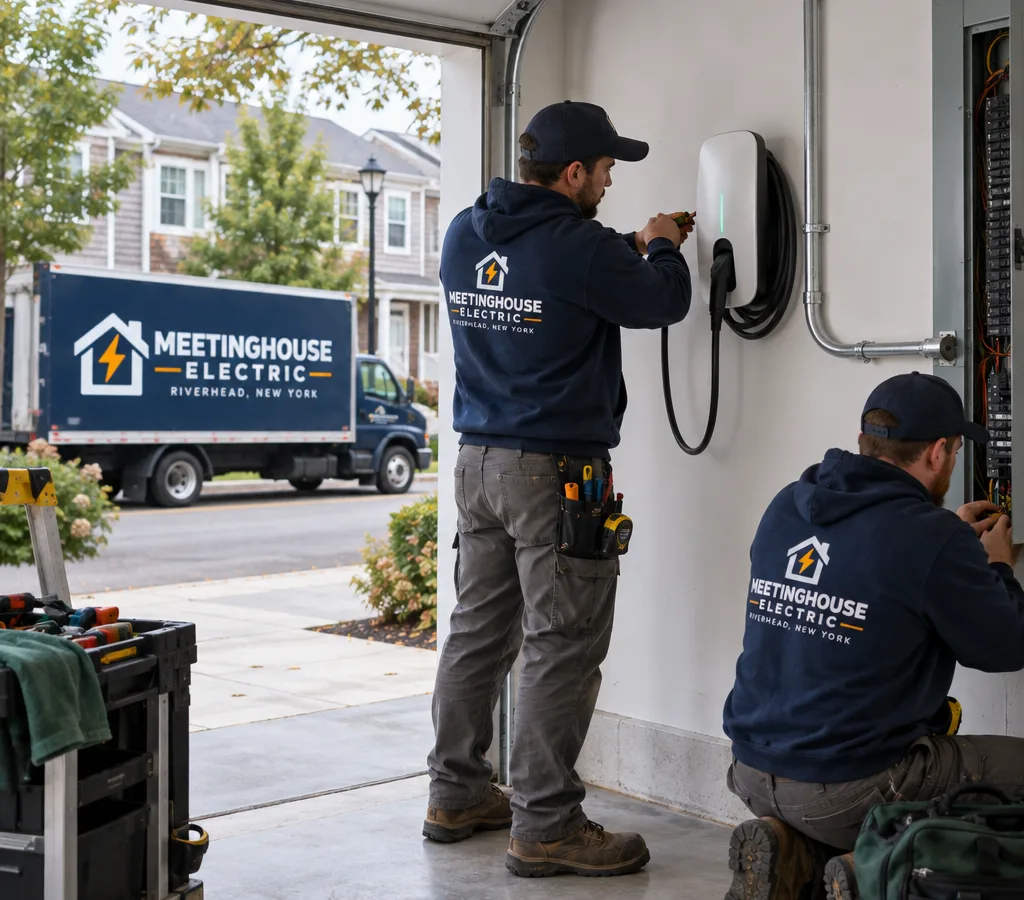
EV charger installation · Suffolk County, New York
Charge faster at home with a dedicated circuit, correctly sized breaker, and clean, code-compliant wiring tailored to your panel and your EVSE.
Call Now +1 631 641 8012Home EV charging
A dependable Level 2 setup starts with the electrical work behind the charger: the right circuit, the right conductor size, proper overcurrent protection, and a safe path from your panel to where you park. Meetinghouse Electric handles level 2 EV charger installation for homeowners in Riverhead and across Suffolk County, NY, with clear communication and workmanship that's built around local code requirements and real-world use.
We work throughout the East End of Long Island and bring the same approach to every job: verify capacity, plan the route, install cleanly, and confirm operation. We're our trusted electricians, and we focus on safe, code-compliant electrical work for homes and businesses.
Installation scope
Most installations come down to four parts: power at the panel, a dedicated branch circuit, a safe wiring method, and mounting the EVSE—the charging equipment—where it's usable and protected.
For a typical home setup, we:
If your existing panel is full or undersized for the new load, we'll explain the options before work starts. Some homes need load management or a service or panel upgrade for a clean, safe install; that is evaluated case by case.
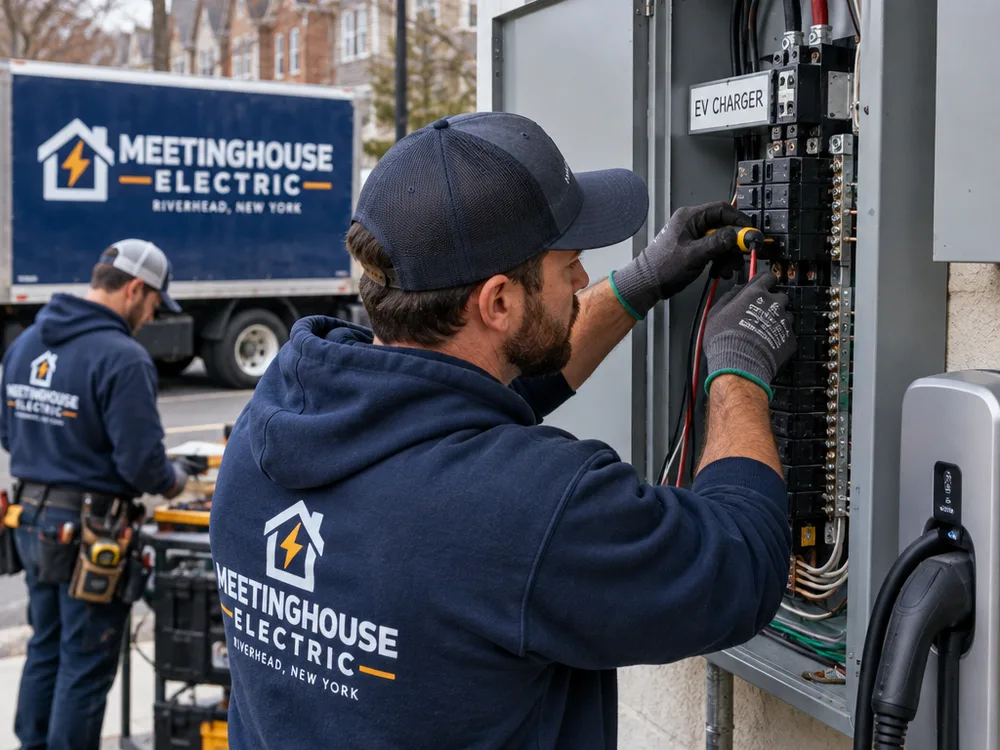
Installation details
Level 2 EVSEs are continuous loads, so the circuit rating and conductor size must match the unit and how it will be used. We verify the charger specs and build the circuit to match.
Before we add a new 240V circuit, we check for available breaker spaces and assess your existing service and load so the install isn't built on guesswork.
We plan cable and conduit routes to minimize exposure to physical damage in garages and exterior runs, and to keep the finished installation tidy and serviceable.
If your EVSE supports either option, we'll walk through practical tradeoffs like disconnecting, cord management, and how the equipment is listed to be installed.
EV charging often triggers electrical permits depending on the scope and local requirements. We install with inspections in mind so approvals are straightforward.
You'll get a written scope that explains the circuit, the routing plan, and any constraints we find at the panel or at the charger location.
Serving Suffolk County
Explore our local electrician services across Suffolk County.
Residential and commercial electrical service throughout Suffolk County.
Electrical repairs, upgrades, troubleshooting, and installations in Riverhead.
Dependable electrical work for homes and businesses in Hampton Bays.
Electrical repairs and installations for Southampton properties.
Wiring, panel, lighting, repair, and installation services in East Hampton.
Wiring, panel upgrades, lighting, and electrical troubleshooting in Manorville.
Installation process
We look at your electrical service, main panel or subpanel, available spaces, and the physical path to the parking spot. We also confirm the EVSE model, planned amperage, and whether it will be hardwired or plug-in.
We determine the correct breaker size, wire size, and wiring method for the run. Then we plan the route that keeps the installation protected and neat, including any penetrations between spaces.
We install the new breaker, run conductors, mount the charger, make terminations to manufacturer specifications, and label the circuit so it's clear for future service.
We verify correct voltage, proper operation, and basic charger functionality. You'll also get a walk-through of the shutoff point and what to watch for during everyday use.
Pricing guidance
Level 2 EV charger installation in Riverhead typically ranges from about $900 to $2,500 for most homes, with higher totals when a long wire run, panel modifications, or service upgrades are needed. A straightforward garage install close to the electrical panel is usually at the lower end, while longer exterior runs or complex routing trend higher.
Your final price depends on charger type—hardwired versus receptacle—circuit amperage, distance from panel to EVSE, access for routing, and whether your panel has capacity and open spaces. Exact cost is confirmed after an on-site evaluation of your panel and the intended charger location.
Local conditions
Homes around Riverhead and the East End often have garages, detached structures, or long runs from a basement panel to an exterior wall. Distance and access are usually the biggest drivers of labor and materials because conductor size, conduit routing, and penetrations all change with the path.
We also see a mix of older panels and newer builds across Suffolk County, which affects how easily a dedicated 240V circuit can be added. If the panel is at capacity, we'll discuss practical paths forward, including whether a subpanel, load management approach, or a full service upgrade is the right fit for your charging goals.
If you're also planning a larger electrical refresh for the property, a full electrical panel upgrade can be timed to support EV charging and other new loads.
If you have the charger picked out—or you're still comparing models—we can confirm compatibility, circuit requirements, and the cleanest route from your panel to the parking spot.
Call for a Free EstimatePractical questions
Yes. A Level 2 EVSE should be on a dedicated 240V branch circuit sized to the unit's nameplate rating. That circuit includes its own correctly sized double-pole breaker and properly sized conductors, and it is installed to continuous-load requirements.
Neither is automatically better; it depends on your charger and how you want to use it. Hardwiring can be a clean, permanent installation, while a receptacle can make it easier to swap equipment later if the EVSE is designed for plug-in use. We confirm what the EVSE is listed for and what fits the location and circuit size.
Often, yes, but it may require changes. If there are no available breaker spaces or the service and load are tight, the fix might be a subpanel, a load management strategy, or a service or panel upgrade depending on what we find during the evaluation.
Many straightforward installs can be completed in a single visit once the scope is confirmed, while longer runs, complex routing, or panel work can extend the timeline. The biggest factors are access for wiring or conduit and whether any panel modifications are required.
Most Level 2 home charging uses a standard connector depending on your vehicle, and the electrical requirements come from the EVSE's rated output and installation method. If you share the EV model and the EVSE model you're considering, we can confirm the electrical requirements before installation.
We install with inspection standards in mind and can coordinate the electrical scope so it's ready for permitting and inspection when required. Requirements vary by municipality, so we confirm the process based on the job location and the scope of electrical work.
The best spot is where the cord reaches the vehicle charge port without crossing walk paths or stressing the cable, and where the wiring route can be protected. We also account for door tracks, shelving, and whether the vehicle backs in or pulls in forward.
Have the EVSE model—or a short list—ready and identify where you want to park and charge. If possible, make the electrical panel accessible and clear the wall area where the charger will be mounted so we can confirm routing and placement efficiently.
Tell Meetinghouse Electric where you park, what EVSE you're using—or considering—and what you want for charging speed. We'll confirm panel capacity, design the dedicated circuit, and provide a clear scope for your Riverhead or Suffolk County installation.